Press kit for the Coexistence Press Release 2026
Overview:
Context for editors
QKD is often presented as a future-proof security technology, but its deployment depends, among other things, on a very practical question: where does it fit inside existing telecom infrastructure?
Without coexistence, QKD can require dedicated fiber resources or separate optical paths. For operators, this creates a bottleneck: fiber is limited, costly to reserve and difficult to manage alongside high-capacity transport traffic.
The SEQRET validation directly addresses this challenge by showing that QKD can run alongside classical high-capacity data traffic on the same standard fiber infrastructure. This helps shift QKD from a separate deployment model toward practical integration into existing optical transport networks.
Press Release (EN)
Existing fiber networks can now carry both: quantum-secure communication and high-capacity data traffic
Fürth, Germany 2026-07-02
KEEQuant, together with consortium partners CESNET, EXATEL and PCSS, validated the system in a representative modern optical transport network environment, demonstrating quantum-secure communication alongside high-capacity transport traffic over distances of up to 75 km without dedicated dark fiber.
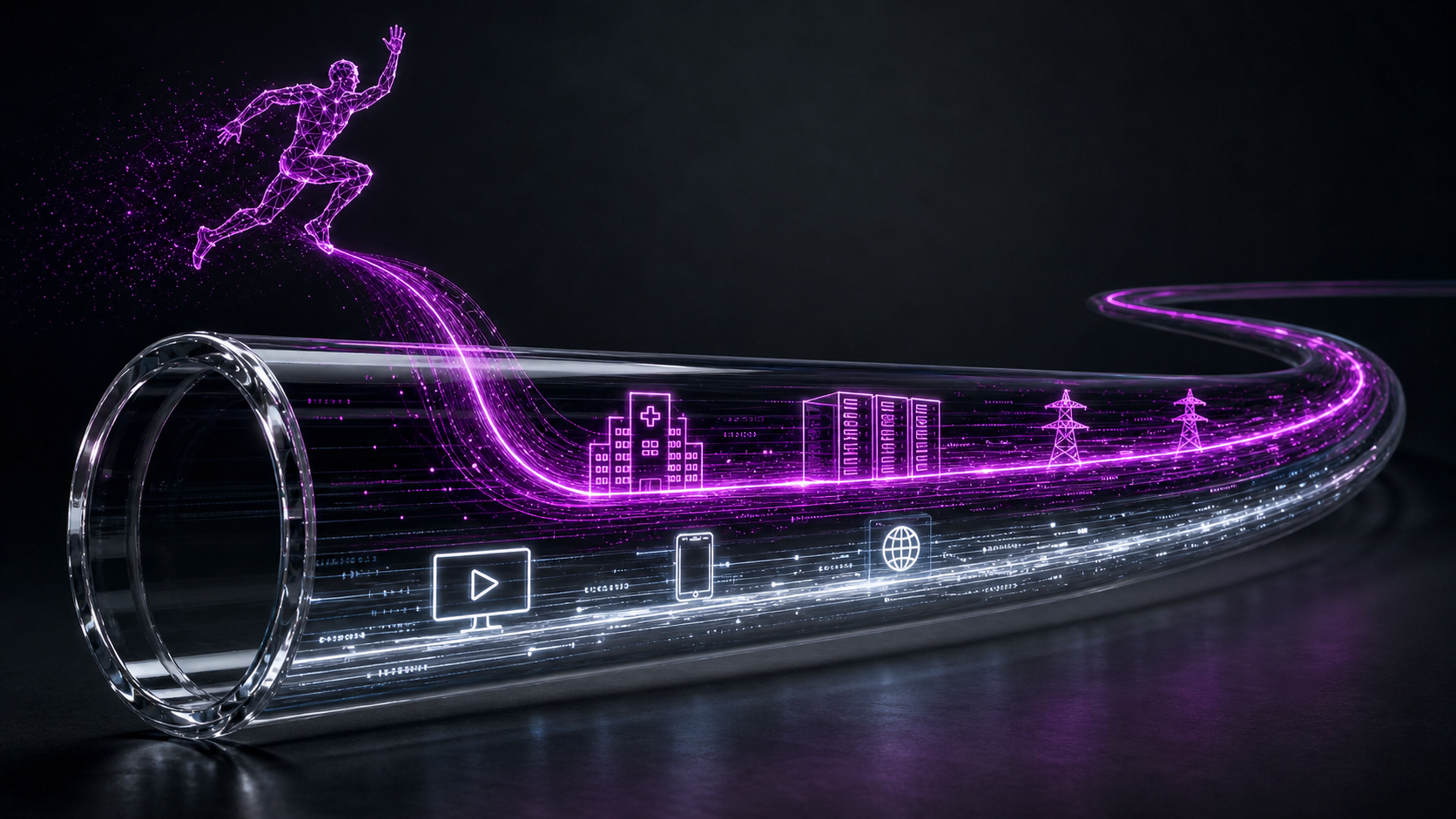
AI-generated Illustration: A visualization of QKD integration into existing transport infrastructure: QKD, shown as a purple quantum stream, joins classical high-capacity data traffic inside the same standard fiber.
The SEQRET consortium partners have validated that existing fiber networks can support quantum-secure communication alongside high-capacity data traffic on the same standard fiber pair. The system demonstrated quantum key distribution (QKD) together with up to 64 Tb/s of classical data traffic and reached distances of up to 75 km. The result directly addresses the dark-fiber bottleneck by showing that quantum-secure communication and high-capacity data traffic can coexist on the same fiber infrastructure used in optical transport networks.
This is particularly relevant for operators and infrastructure stakeholders because fiber scarcity is frequently the primary deployment obstacle. Reserving separate fiber for QKD can be costly and operationally difficult, especially in high-capacity transport networks. Coexistence changes that equation by allowing QKD to run on the same optical infrastructure as classical data traffic. This contributes to a reduction in deployment friction and enhances the practical fit of quantum-safe keying within telecom networks. The strategic consequence is clear: QKD can be introduced into installed transport infrastructure without a parallel dark-fiber build out or major network redesign.
“For operators serving critical-infrastructure and public-sector customers, trust depends on evidence. This validation provides exactly that: a concrete basis for evaluating how quantum-secure key distribution can be integrated into reliable, security-sensitive network services,” says Mateusz Ozimek, who leads the SEQRET project at EXATEL and works there as Head of the Space Technologies Team.
The validation was performed in a two-node setup over standard G.652.D fiber. To reflect representative network conditions, six optical transceivers were employed, while the rest of the optical transport environment was filled with noise loaded channels to emulate a fully populated DWDM line. In parallel, a KEEQuant QKD module generated cryptographic keys, which were delivered through the KEEQuant Key Management System (KMS) to an encryptor. A live encrypted video stream was transmitted using end-to-end encryption, showing a system-level implementation rather than an isolated component result.
Stable coexistence was demonstrated across three operating points:
- 80 × 800 Gb/s (64 Tb/s) across the C- and L-band over 60 km
- 40 × 800 Gb/s (32 Tb/s) in the C-band over 65 km
- 80 × 400 Gb/s (32 Tb/s) across the C- and L-band over 75 km
The result points to a practical route for integrating QKD into existing optical transport infrastructure with lower deployment friction and without reducing available payload capacity.
The demonstration brought together the complementary expertise of several project partners. KEEQuant (Germany) provided the QKD and key management systems and led the overall integration concept and end-to-end demonstration. EXATEL (Poland) contributed the telecommunications operator perspective, defining the operational requirements for real-world network deployment. CESNET (Czech Republic) provided an advanced testbed environment and supported the validation process, while PCSS (Poland) supplied the optical fibers used for range testing.
Funding
This work was carried out with the SEQRET project. The project is funded under the Digital Europe Programme within the framework of EuroQCI under the DIGITAL-2021-GCI-01-INDUSTRIAL call with the project ID 101091591
Acknowledgements
KEEQuant thanks Ribbon for providing the encryption cards.
Consortium and Press Contacts
KEEQuant GmbH, develops deployable quantum-security technologies including quantum key distribution, key management and secure networking solutions for confidentiality-sensitive infrastructures (Germany)
E-Mail: press@keequant.com
EXATEL, leading provider of telecommunications, ICT, and cybersecurity technologies (Poland)
E-Mail: biuroprasowe@exatel.pl
CESNET, Czech Education and Scientific Network (Czech Republic)
E-Mail: marketing@cesnet.cz
PCSS, Poznan Supercomputing and Networking Center (Poland)
E-Mail: pr@man.poznan.pl
Press Release (DE)
In bestehenden Glasfasernetzen ist jetzt quantensichere Kommunikation und hochkapazitiver Datenverkehr gleichzeitig möglich
Fürth, Deutschland 02.07.2026
KEEQuant hat das System gemeinsam mit den Konsortialpartnern CESNET, EXATEL und PCSS in einer repräsentativen Umgebung moderner optischer Transportnetze validiert. Dabei wurde quantensichere Kommunikation parallel zu hochkapazitivem Transportdatenverkehr über Distanzen von bis zu 75 km demonstriert, ohne auf eine dedizierte Dark Fiber zurückzugreifen.
KI-generierte Illustration: Visualisierung der QKD-Integration in bestehende Transportinfrastruktur: QKD, dargestellt als violetter Quantenstrom, wird gemeinsam mit klassischem hochkapazitivem Datenverkehr innerhalb derselben Standardglasfaser übertragen.
Die Partner des SEQRET-Konsortiums haben validiert, dass bestehende Glasfasernetze quantensichere Kommunikation und hochkapazitiven Datenverkehr auf demselben Standard-Glasfaserpaar unterstützen können. Das System demonstrierte Quanten-Schlüsselverteilung (engl.: Quantum Key Distribution, QKD) gemeinsam mit bis zu 64 Tb/s an klassischem Datenverkehr und erreichte Distanzen von bis zu 75 km. Dieses Ergebnis adressiert den Dark-Fiber-Engpass direkt, indem es aufzeigt, dass quantensichere Kommunikation und hochkapazitiver Datenverkehr auf derselben Glasfaserinfrastruktur koexistieren können, wie sie auch in optischen Transportnetzen eingesetzt wird.
Das ist besonders relevant für Betreiber und Infrastrukturverantwortliche, da die Verfügbarkeit von Glasfaser häufig eines der zentralen Hindernisse für die Implementierung ist. Separate Glasfasern für QKD zu reservieren, kann kostspielig und operativ anspruchsvoll sein, insbesondere in hochkapazitiven Transportnetzen. Koexistenz verändert diese Ausgangslage, da QKD auf derselben optischen Infrastruktur betrieben werden kann wie klassischer Datenverkehr. Dadurch wird die Implementierung vereinfacht und die praktische Integration quantensicherer Schlüsselverteilung in Telekommunikationsnetze verbessert. Die strategische Konsequenz ist klar: QKD kann in bestehende Transportinfrastrukturen eingeführt werden, ohne ein paralleles Dark-Fiber-Netz aufzubauen oder das Netzwerk grundlegend neu zu gestalten.
„Für Betreiber, die Kunden aus kritischen Infrastrukturen und dem öffentlichen Sektor bedienen, basiert Vertrauen auf belastbaren Nachweisen. Diese Validierung liefert genau das: eine konkrete Grundlage, um zu bewerten, wie quantensichere Schlüsselverteilung in vertrauenswürdige, sicherheitssensible Netzwerkdienste integriert werden kann“, sagt Mateusz Ozimek, der das SEQRET-Projekt auf Seiten von EXATEL leitet und dort als Leiter des Teams für Weltraumtechnologien tätig ist.
Die Validierung wurde in einem Zwei-Knoten-Aufbau über Standard-G.652.D-Glasfaser durchgeführt. Um repräsentative Netzwerkbedingungen abzubilden, wurden sechs optische Transceiver eingesetzt, während die verbleibende optische Transportumgebung mit Rauschsignalen belegt wurde, um eine vollständig belegte DWDM-Strecke zu emulieren. Parallel dazu erzeugte ein KEEQuant QKD-Modul kryptografische Schlüssel, die über das Schlüsselmanagementsystem (engl.: Key Management System, KMS) an einen Encryptor übergeben wurden. Ein live verschlüsselter Videostream wurde mit Ende-zu-Ende-Verschlüsselung übertragen und zeigte damit eine Implementierung auf Systemebene – nicht nur die isolierte Funktion eines einzelnen Moduls.
Eine stabile Koexistenz wurde an drei Betriebspunkten demonstriert:
• 80 × 800 (Gb/s 64 Tb/s) über C- und L-Band auf einer Strecke von 60 km
• 40 × 800 (Gb/s 32 Tb/s) im C-Band auf einer Strecke von 65 km
• 80 × 400 (Gb/s 32 Tb/s) über C- und L-Band auf einer Strecke von 75 km
Das Ergebnis zeigt einen praktischen Weg auf, QKD mit geringerem Implementierungsaufwand in bestehende optische Transportinfrastrukturen zu integrieren – ohne die verfügbare Kapazität für Nutzdaten zu reduzieren.
Die Demonstration vereinte die komplementäre Expertise mehrerer Projektpartner. KEEQuant (Deutschland) stellte das QKD-System bereit und verantwortete das Integrationskonzept, das Key-Management-System sowie die Ende-zu-Ende-Demonstration. EXATEL (Polen) brachte die Perspektive eines Telekommunikationsbetreibers ein und definierte die operativen Anforderungen für den Einsatz in realen Netzumgebungen. CESNET (Tschechische Republik) stellte eine fortschrittliche Testumgebung bereit und unterstützte die Validierung, während PCSS (Polen) die optischen Fasern für die Reichweitentests lieferte.
Förderung
Diese Arbeit wurde im Rahmen des SEQRET-Projekts durchgeführt. Das Projekt wird im Rahmen des Digitalen Europa Programms im Kontext von EuroQCI unter dem Call DIGITAL-2021-GCI-01-INDUSTRIAL mit der Projekt-ID 101091591 gefördert.
Anerkennung
KEEQuant bedankt sich bei Ribbon für die Bereitstellung der Encryption Cards.
Konsortium und Pressekontakte
KEEQuant GmbH, entwickelt Quantensicherheitstechnologien, darunter Quantenschlüsselverteilung, Schlüsselverwaltung und sichere Netzwerklösungen für Infrastrukturen, die ein hohes Maß an Vertraulichkeit erfordern (Deutschland)
E-Mail: press@keequant.com
EXATEL, führender Anbieter von Telekommunikations-, IKT- und Cybersicherheitstechnologien (Polen)
E-Mail: biuroprasowe@exatel.pl
CESNET, tschechisches Bildungs- und Wissenschaftsnetz (Tschechische Republik)
E-Mail: marketing@cesnet.cz
PCSS, Poznań Supercomputing and Networking Center (Polen)
E-Mail: pr@man.poznan.pl
Usage rights and permissions
Press release text
This press release may be reproduced, republished, and shared in whole or in part for editorial, news, and informational purposes, provided KEEQuant GmbH is credited as the source.
Image and media assets
Unless otherwise indicated, photographs, renderings, and other media assets on this page are provided solely for editorial use in connection with coverage of this announcement and/or KEEQuant GmbH. Please credit: KEEQuant GmbH. No use for advertising, merchandising, resale, or other commercial exploitation. No alterations except proportionate cropping, resizing, and minor technical adjustments. All other rights reserved.
Ressources
Press Release (EN)
Existing fiber networks can now carry both: quantum-secure communication and high-capacity data traffic
Fürth, Germany 2026-07-02
KEEQuant, together with consortium partners CESNET, EXATEL and PCSS, validated the system in a representative modern optical transport network environment, demonstrating quantum-secure communication alongside high-capacity transport traffic over distances of up to 75 km without dedicated dark fiber.
AI-generated Illustration: A visualization of QKD integration into existing transport infrastructure: QKD, shown as a purple quantum stream, joins classical high-capacity data traffic inside the same standard fiber.
The SEQRET consortium partners have validated that existing fiber networks can support quantum-secure communication alongside high-capacity data traffic on the same standard fiber pair. The system demonstrated quantum key distribution (QKD) together with up to 64 Tb/s of classical data traffic and reached distances of up to 75 km. The result directly addresses the dark-fiber bottleneck by showing that quantum-secure communication and high-capacity data traffic can coexist on the same fiber infrastructure used in optical transport networks.
This is particularly relevant for operators and infrastructure stakeholders because fiber scarcity is frequently the primary deployment obstacle. Reserving separate fiber for QKD can be costly and operationally difficult, especially in high-capacity transport networks. Coexistence changes that equation by allowing QKD to run on the same optical infrastructure as classical data traffic. This contributes to a reduction in deployment friction and enhances the practical fit of quantum-safe keying within telecom networks. The strategic consequence is clear: QKD can be introduced into installed transport infrastructure without a parallel dark-fiber build out or major network redesign.
“For operators serving critical-infrastructure and public-sector customers, trust depends on evidence. This validation provides exactly that: a concrete basis for evaluating how quantum-secure key distribution can be integrated into reliable, security-sensitive network services,” says Mateusz Ozimek, who leads the SEQRET project at EXATEL and works there as Head of the Space Technologies Team.
The validation was performed in a two-node setup over standard G.652.D fiber. To reflect representative network conditions, six optical transceivers were employed, while the rest of the optical transport environment was filled with noise loaded channels to emulate a fully populated DWDM line. In parallel, a KEEQuant QKD module generated cryptographic keys, which were delivered through the KEEQuant Key Management System (KMS) to an encryptor. A live encrypted video stream was transmitted using end-to-end encryption, showing a system-level implementation rather than an isolated component result.
Stable coexistence was demonstrated across three operating points:
- 80 × 800 Gb/s (64 Tb/s) across the C- and L-band over 60 km
- 40 × 800 Gb/s (32 Tb/s) in the C-band over 65 km
- 80 × 400 Gb/s (32 Tb/s) across the C- and L-band over 75 km
The result points to a practical route for integrating QKD into existing optical transport infrastructure with lower deployment friction and without reducing available payload capacity.
The demonstration brought together the complementary expertise of several project partners. KEEQuant (Germany) provided the QKD and key management systems and led the overall integration concept and end-to-end demonstration. EXATEL (Poland) contributed the telecommunications operator perspective, defining the operational requirements for real-world network deployment. CESNET (Czech Republic) provided an advanced testbed environment and supported the validation process, while PCSS (Poland) supplied the optical fibers used for range testing.
Funding
This work was carried out with the SEQRET project. The project is funded under the Digital Europe Programme within the framework of EuroQCI under the DIGITAL-2021-GCI-01-INDUSTRIAL call with the project ID 101091591
Acknowledgements
KEEQuant thanks Ribbon for providing the encryption cards.
Consortium and Press Contacts
KEEQuant GmbH, develops deployable quantum-security technologies including quantum key distribution, key management and secure networking solutions for confidentiality-sensitive infrastructures (Germany)
E-Mail: press@keequant.com
EXATEL, leading provider of telecommunications, ICT, and cybersecurity technologies (Poland)
E-Mail: biuroprasowe@exatel.pl
CESNET, Czech Education and Scientific Network (Czech Republic)
E-Mail: marketing@cesnet.cz
PCSS, Poznan Supercomputing and Networking Center (Poland)
E-Mail: pr@man.poznan.pl
Press Release (DE)
In bestehenden Glasfasernetzen ist jetzt quantensichere Kommunikation und hochkapazitiver Datenverkehr gleichzeitig möglich
Fürth, Deutschland 02.07.2026
KEEQuant hat das System gemeinsam mit den Konsortialpartnern CESNET, EXATEL und PCSS in einer repräsentativen Umgebung moderner optischer Transportnetze validiert. Dabei wurde quantensichere Kommunikation parallel zu hochkapazitivem Transportdatenverkehr über Distanzen von bis zu 75 km demonstriert, ohne auf eine dedizierte Dark Fiber zurückzugreifen.
KI-generierte Illustration: Visualisierung der QKD-Integration in bestehende Transportinfrastruktur: QKD, dargestellt als violetter Quantenstrom, wird gemeinsam mit klassischem hochkapazitivem Datenverkehr innerhalb derselben Standardglasfaser übertragen.
Die Partner des SEQRET-Konsortiums haben validiert, dass bestehende Glasfasernetze quantensichere Kommunikation und hochkapazitiven Datenverkehr auf demselben Standard-Glasfaserpaar unterstützen können. Das System demonstrierte Quanten-Schlüsselverteilung (engl.: Quantum Key Distribution, QKD) gemeinsam mit bis zu 64 Tb/s an klassischem Datenverkehr und erreichte Distanzen von bis zu 75 km. Dieses Ergebnis adressiert den Dark-Fiber-Engpass direkt, indem es aufzeigt, dass quantensichere Kommunikation und hochkapazitiver Datenverkehr auf derselben Glasfaserinfrastruktur koexistieren können, wie sie auch in optischen Transportnetzen eingesetzt wird.
Das ist besonders relevant für Betreiber und Infrastrukturverantwortliche, da die Verfügbarkeit von Glasfaser häufig eines der zentralen Hindernisse für die Implementierung ist. Separate Glasfasern für QKD zu reservieren, kann kostspielig und operativ anspruchsvoll sein, insbesondere in hochkapazitiven Transportnetzen. Koexistenz verändert diese Ausgangslage, da QKD auf derselben optischen Infrastruktur betrieben werden kann wie klassischer Datenverkehr. Dadurch wird die Implementierung vereinfacht und die praktische Integration quantensicherer Schlüsselverteilung in Telekommunikationsnetze verbessert. Die strategische Konsequenz ist klar: QKD kann in bestehende Transportinfrastrukturen eingeführt werden, ohne ein paralleles Dark-Fiber-Netz aufzubauen oder das Netzwerk grundlegend neu zu gestalten.
„Für Betreiber, die Kunden aus kritischen Infrastrukturen und dem öffentlichen Sektor bedienen, basiert Vertrauen auf belastbaren Nachweisen. Diese Validierung liefert genau das: eine konkrete Grundlage, um zu bewerten, wie quantensichere Schlüsselverteilung in vertrauenswürdige, sicherheitssensible Netzwerkdienste integriert werden kann“, sagt Mateusz Ozimek, der das SEQRET-Projekt auf Seiten von EXATEL leitet und dort als Leiter des Teams für Weltraumtechnologien tätig ist.
Die Validierung wurde in einem Zwei-Knoten-Aufbau über Standard-G.652.D-Glasfaser durchgeführt. Um repräsentative Netzwerkbedingungen abzubilden, wurden sechs optische Transceiver eingesetzt, während die verbleibende optische Transportumgebung mit Rauschsignalen belegt wurde, um eine vollständig belegte DWDM-Strecke zu emulieren. Parallel dazu erzeugte ein KEEQuant QKD-Modul kryptografische Schlüssel, die über das Schlüsselmanagementsystem (engl.: Key Management System, KMS) an einen Encryptor übergeben wurden. Ein live verschlüsselter Videostream wurde mit Ende-zu-Ende-Verschlüsselung übertragen und zeigte damit eine Implementierung auf Systemebene – nicht nur die isolierte Funktion eines einzelnen Moduls.
Eine stabile Koexistenz wurde an drei Betriebspunkten demonstriert:
• 80 × 800 (Gb/s 64 Tb/s) über C- und L-Band auf einer Strecke von 60 km
• 40 × 800 (Gb/s 32 Tb/s) im C-Band auf einer Strecke von 65 km
• 80 × 400 (Gb/s 32 Tb/s) über C- und L-Band auf einer Strecke von 75 km
Das Ergebnis zeigt einen praktischen Weg auf, QKD mit geringerem Implementierungsaufwand in bestehende optische Transportinfrastrukturen zu integrieren – ohne die verfügbare Kapazität für Nutzdaten zu reduzieren.
Die Demonstration vereinte die komplementäre Expertise mehrerer Projektpartner. KEEQuant (Deutschland) stellte das QKD-System bereit und verantwortete das Integrationskonzept, das Key-Management-System sowie die Ende-zu-Ende-Demonstration. EXATEL (Polen) brachte die Perspektive eines Telekommunikationsbetreibers ein und definierte die operativen Anforderungen für den Einsatz in realen Netzumgebungen. CESNET (Tschechische Republik) stellte eine fortschrittliche Testumgebung bereit und unterstützte die Validierung, während PCSS (Polen) die optischen Fasern für die Reichweitentests lieferte.
Förderung
Diese Arbeit wurde im Rahmen des SEQRET-Projekts durchgeführt. Das Projekt wird im Rahmen des Digitalen Europa Programms im Kontext von EuroQCI unter dem Call DIGITAL-2021-GCI-01-INDUSTRIAL mit der Projekt-ID 101091591 gefördert.
Anerkennung
KEEQuant bedankt sich bei Ribbon für die Bereitstellung der Encryption Cards.
Konsortium und Pressekontakte
KEEQuant GmbH, entwickelt Quantensicherheitstechnologien, darunter Quantenschlüsselverteilung, Schlüsselverwaltung und sichere Netzwerklösungen für Infrastrukturen, die ein hohes Maß an Vertraulichkeit erfordern (Deutschland)
E-Mail: press@keequant.com
EXATEL, führender Anbieter von Telekommunikations-, IKT- und Cybersicherheitstechnologien (Polen)
E-Mail: biuroprasowe@exatel.pl
CESNET, tschechisches Bildungs- und Wissenschaftsnetz (Tschechische Republik)
E-Mail: marketing@cesnet.cz
PCSS, Poznań Supercomputing and Networking Center (Polen)
E-Mail: pr@man.poznan.pl
Usage rights and permissions
Press release text
This press release may be reproduced, republished, and shared in whole or in part for editorial, news, and informational purposes, provided KEEQuant GmbH is credited as the source.
Image and media assets
Unless otherwise indicated, photographs, renderings, and other media assets on this page are provided solely for editorial use in connection with coverage of this announcement and/or KEEQuant GmbH. Please credit: KEEQuant GmbH. No use for advertising, merchandising, resale, or other commercial exploitation. No alterations except proportionate cropping, resizing, and minor technical adjustments. All other rights reserved.
Press release:
Image:
Logos: