
Optical wireless quantum secure communication: free-space QKD and Li-Fi in one system
Fürth, Germany 2026-05-26
The German consortium QuINSiDa has achieved a major step towards mobile quantum-secure communication. They demonstrated a one-of-a-kind free-space data transfer channel supporting, for the first time, LiFi and major quantum key distribution (QKD) implementations. Additionally, the system integrates key management (KMS), encryption, and monitoring, illustrating technological readiness. This architecture enables quantum-secure key delivery without relying on fiber or radio, opening new possibilities for high-security networks where flexible infrastructure is desirable.

Illustration of the QuINSiDa vision: quantum-secure optical wireless links between fixed infrastructure and mobile platforms (e.g., vehicles, vessels, drones, etc.) – using free-space QKD and Li-Fi integrated with key management, encryption and network monitoring.
So far, most quantum communication systems depended on dedicated fiber networks, limiting their flexibility. QuINSiDa has now demonstrated an integrated optical-wireless quantum security stack in the laboratory, combining free-space Continuous- and Discrete-Variable QKD (CV/DV-QKD) with Li-Fi and connecting the result to key management, encryption and monitoring. The setup operates over a line-of-sight optical link, enabling quantum-secure key distribution for civil critical infrastructure applications, including maritime and harbor connectivity, industrial campuses, aviation, automotive environments, temporary secure networks and fixed-to-mobile links. The design allows to conveniently deploy and monitor the system while remaining compatible with existing security workflows.
With this achievement, Germany steps closer to a future where quantum-secure communication is moving towards mobile security applications, that can be deployed wherever optical wireless links are feasible. This brings quantum-secure encryption into real-world operations and offers a powerful tool for securing critical infrastructure.
Technical highlights
The breakthrough lies in a combination of Li-Fi and QKD that enables line-of-sight communication. In this approach, Li-Fi and QKD are integrated into the same wireless environment:
- Continuous-Variable QKD at 1550 nm
- Discrete-Variable QKD at 810 nm
- Li-Fi in the 850–940 nm range.
Wavelength separation and optical filtering allow all three to operate simultaneously without disturbing each other. In the integrated system, the QKD post-processing data is transmitted over the Li-Fi link rather than in a dedicated channel. The Li-Fi connection thus forms the only channel for classical communication, which is an advantageous simplification.
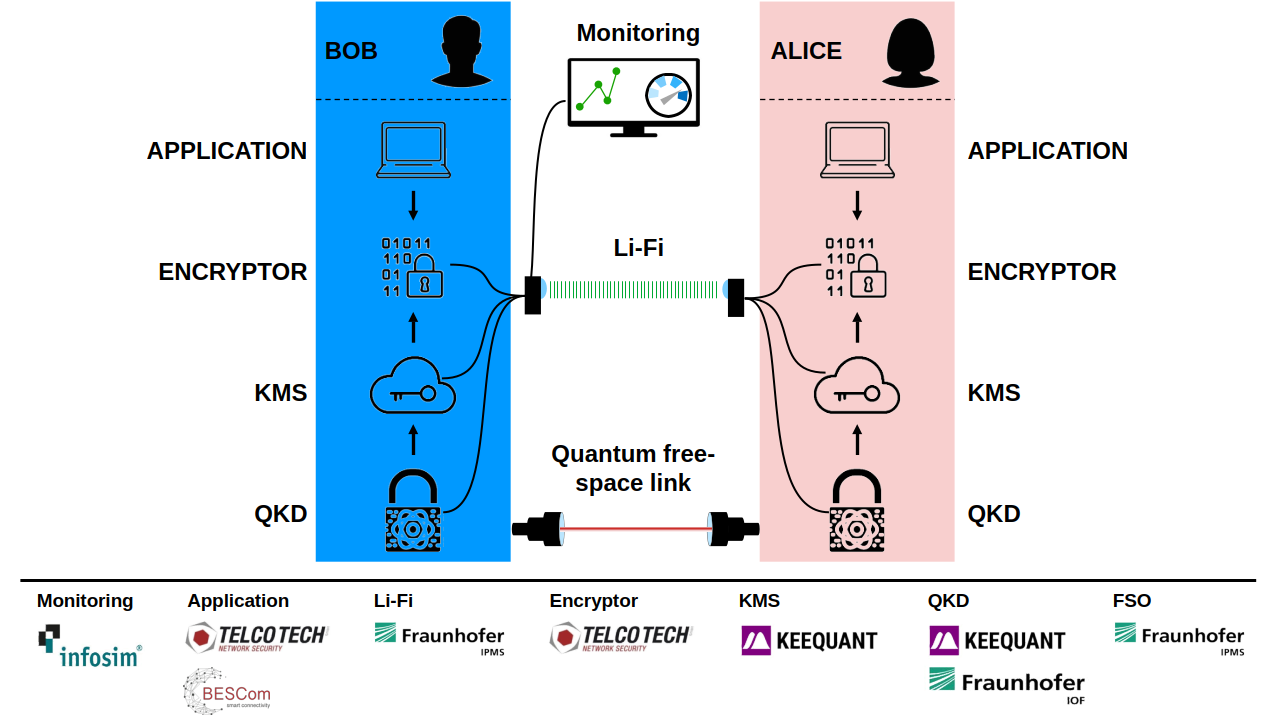
Schematic of the technological stack: at the bottom the QKD system generates quantum-secure key material using both the quantum free-space link (PAT) and the Li-Fi channel. The keys are retrieved and managed by the KMS. The encryptor takes the payload from the user application — say at Bob — and encrypts it with a key from the KMS. The encrypted data is sent to the second party — Alice — over Li-Fi. Alice’s encryptor deciphers the data with the symmetric key retrieved from their synchronized KMS.
Maintaining a stable free-space optical link requires precise alignment, which the QuINSiDa system achieves by using a Pointing/Acquisition/Tracking (PAT) subsystem . Li-Fi supports endpoint identification/localization and provides a feedback channel, enabling PAT to acquire and maintain alignment for the quantum link. The project implemented a coupling/interface concept that can serve both CV-QKD and DV-QKD while preserving the signal properties relevant to QKD. PAT control and telemetry are fully integrated into the overall communications flow.
The QuINSiDa setup focuses on practical operational readiness and integrates key management, encryption, and monitoring. At the same time, network management workflows and telemetry (e.g., via a gNMI-based approach) are adapted to QKD, Li-Fi, and PAT components. The result is an end-to-end system designed not only as a laboratory demonstration, but as a deployable, monitorable, and maintainable solution ready for operational security environments.
Consortium
QuINSiDa was carried out by a consortium of six partners: KEEQuant GmbH (coordination; CV-QKD, key management integration), Fraunhofer Institute for Photonic Microsystems IPMS (Li-Fi and free-space link components; PAT), Fraunhofer Institute for Applied Optics and Precision Engineering IOF (DV-QKD contribution), Infosim GmbH & Co. KG (monitoring/network management system integration), TELCO TECH GmbH (encryption integration), and BESCom Elektronik GmbH (use-case, transfer and dissemination).
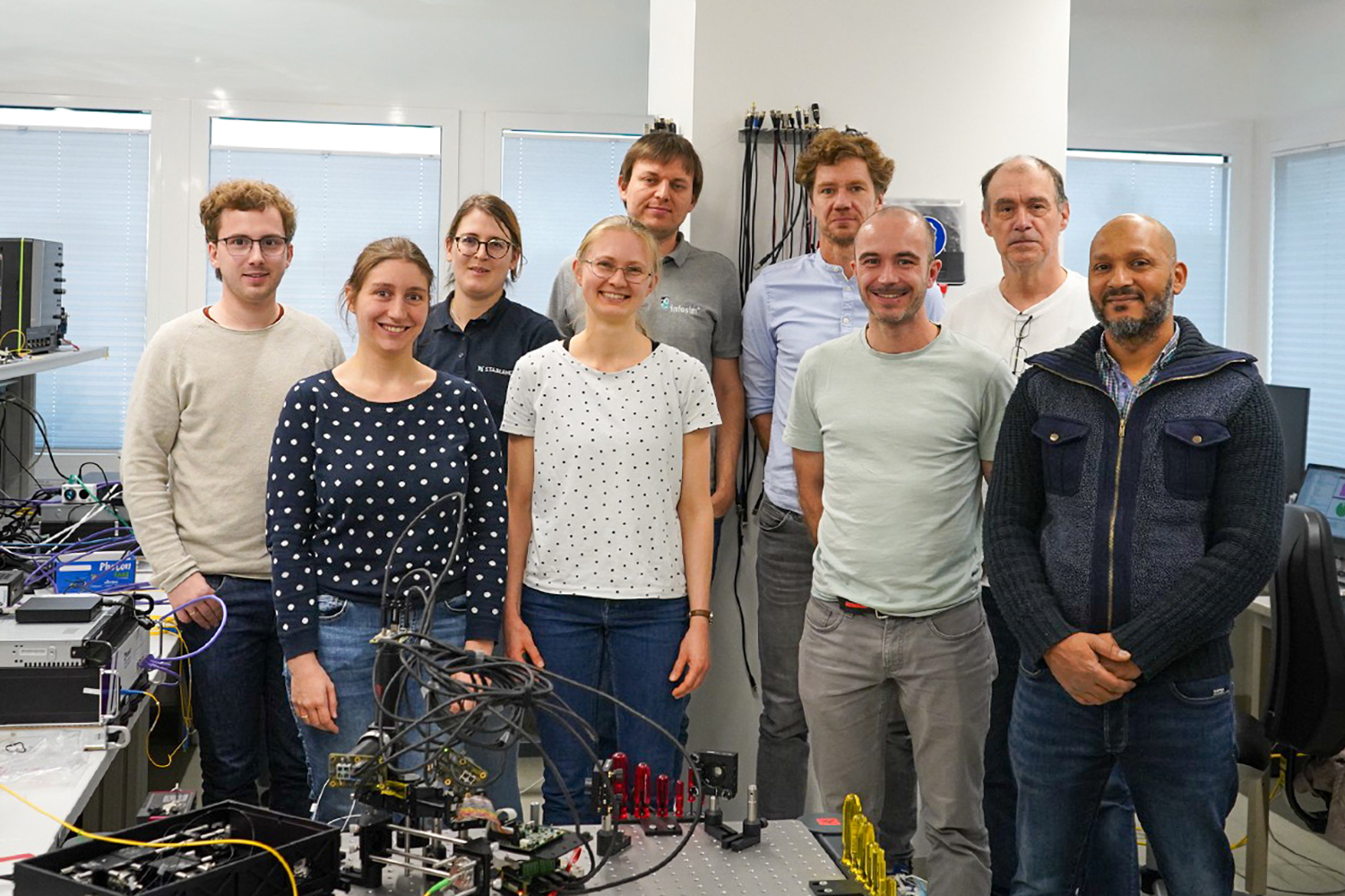
QuINSiDa partners at the final lab demonstration of the integrated optical-wireless security stack.
Press contacts
- KEEQuant GmbH (Coordinator): Imran Khan, press@keequant.com
- Fraunhofer IPMS: Stephan Kube, stephan.kube@ipms.fraunhofer.de
- Fraunhofer IOF: Daniel Heinig, daniel.heinig@iof.fraunhofer.de
- Infosim: Stefan Kremling, kremling@infosim.net
- TELCO TECH: Bernd Schulz, bschulz@telco-tech.de
- BESCom: Faouzi Takni, faouzi.takni@bescom.de
Funding acknowledgment
QuINSiDa was funded by the German Federal Ministry of Research, Technology and Space (BMFTR) under project numbers 16KISQ082K, 16KISQ083-6, within the funding measure “Lokale Netze zur Quantenkommunikation (Q-LAN)”.