
Press kit for the QuINSiDa Press Release 2026
Quick Navigation
Context for editors
QuINSiDa is a reseach project funded by the BMFTR and includes 6 German companies and reserach institutes. It demonstrated how quantum-secure communication can move into optical wireless environments, which brings this much needed – albeit still challenging- capability closer to the market. The project combines free-space QKD and Li-Fi with key management, encryption and monitoring in an integrated laboratory system, pointing toward flexible line-of-sight security links for future infrastructure scenarios. Relevant coverage areas include quantum technology, cybersecurity, photonics, optical wireless communication, telecom, Li-Fi and critical infrastructure.
Press release (short version/EN)
QuINSiDa, a German research consortium, has demonstrated an integrated optical-wireless quantum security system combining free-space QKD, Li-Fi, key management, encryption and monitoring. The laboratory setup shows how quantum-secure key delivery can be connected with flexible line-of-sight communication links beyond conventional fiber-based infrastructure. The result marks an important technology-integration milestone for future secure communication scenarios in industrial, maritime, temporary and fixed-to-mobile environments.
Press release (long version/EN)
Optical wireless quantum secure communication: free-space QKD and Li-Fi in one system
The German consortium QuINSiDa has achieved a major step towards mobile quantum-secure communication. They demonstrated a one-of-a-kind free-space data transfer channel supporting, for the first time, LiFi and major quantum key distribution (QKD) implementations. Additionally, the system integrates key management (KMS), encryption, and monitoring, illustrating technological readiness. This architecture enables quantum-secure key delivery without relying on fiber or radio, opening new possibilities for high-security networks where flexible infrastructure is desirable.

Illustration of the QuINSiDa vision: quantum-secure optical wireless links between fixed infrastructure and mobile platforms (e.g., vehicles, vessels, drones, etc.) – using free-space QKD and Li-Fi integrated with key management, encryption and network monitoring.
So far, most quantum communication systems depended on dedicated fiber networks, limiting their flexibility. QuINSiDa has now demonstrated an integrated optical-wireless quantum security stack in the laboratory, combining free-space Continuous- and Discrete-Variable QKD (CV/DV-QKD) with Li-Fi and connecting the result to key management, encryption and monitoring. The setup operates over a line-of-sight optical link, enabling quantum-secure key distribution for civil critical infrastructure applications, including maritime and harbor connectivity, industrial campuses, aviation, automotive environments, temporary secure networks and fixed-to-mobile links. The design allows to conveniently deploy and monitor the system while remaining compatible with existing security workflows.
With this achievement, Germany steps closer to a future where quantum-secure communication is moving towards mobile security applications, that can be deployed wherever optical wireless links are feasible. This brings quantum-secure encryption into real-world operations and offers a powerful tool for securing critical infrastructure.
Technical highlights
The breakthrough lies in a combination of Li-Fi and QKD that enables line-of-sight communication. In this approach, Li-Fi and QKD are integrated into the same wireless environment:
- Continuous-Variable QKD at 1550 nm
- Discrete-Variable QKD at 810 nm
- Li-Fi in the 850–940 nm range.
Wavelength separation and optical filtering allow all three to operate simultaneously without disturbing each other. In the integrated system, the QKD post-processing data is transmitted over the Li-Fi link rather than in a dedicated channel. The Li-Fi connection thus forms the only channel for classical communication, which is an advantageous simplification.
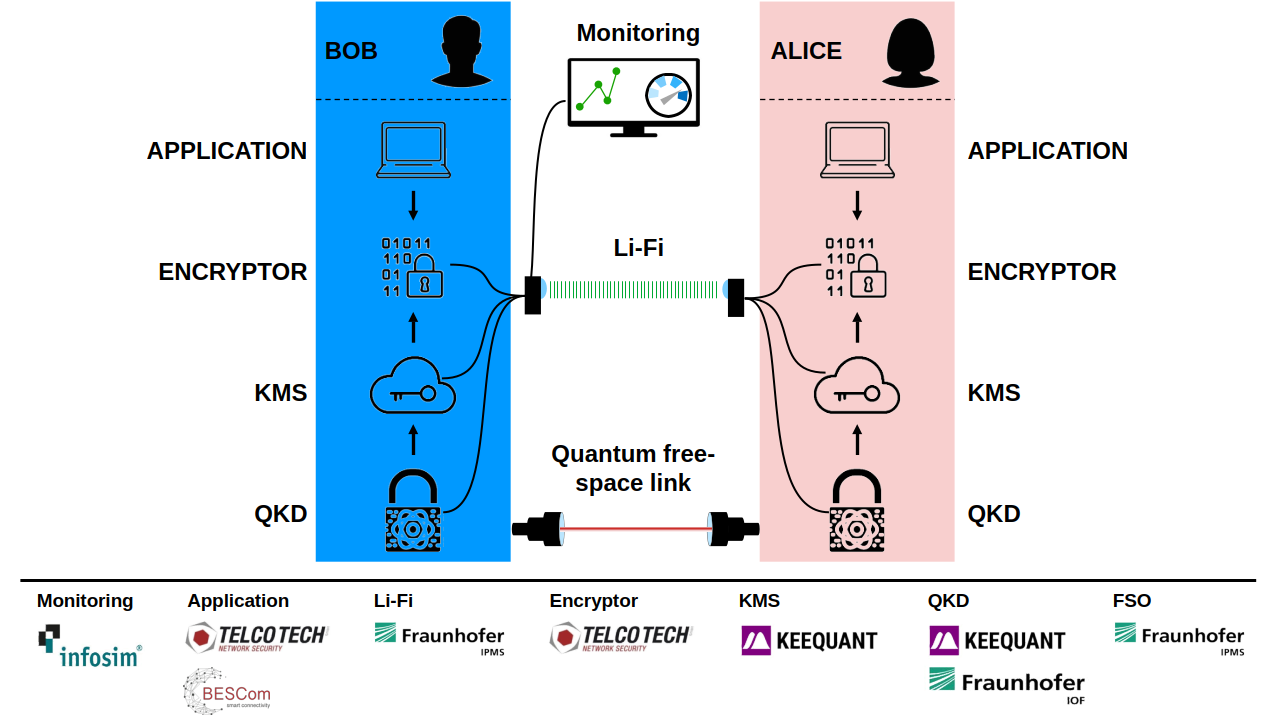
Schematic of the technological stack: at the bottom the QKD system generates quantum-secure key material using both the quantum free-space link (PAT) and the Li-Fi channel. The keys are retrieved and managed by the KMS. The encryptor takes the payload from the user application — say at Bob — and encrypts it with a key from the KMS. The encrypted data is sent to the second party — Alice — over Li-Fi. Alice’s encryptor deciphers the data with the symmetric key retrieved from their synchronized KMS.
Maintaining a stable free-space optical link requires precise alignment, which the QuINSiDa system achieves by using a Pointing/Acquisition/Tracking (PAT) subsystem. Li-Fi supports endpoint identification/localization and provides a feedback channel, enabling PAT to acquire and maintain alignment for the quantum link. The project implemented a coupling/interface concept that can serve both CV-QKD and DV-QKD while preserving the signal properties relevant to QKD. PAT control and telemetry are fully integrated into the overall communications flow.
The QuINSiDa setup focuses on practical operational readiness and integrates key management, encryption, and monitoring. At the same time, network management workflows and telemetry (e.g., via a gNMI-based approach) are adapted to QKD, Li-Fi, and PAT components. The result is an end-to-end system designed not only as a laboratory demonstration, but as a deployable, monitorable, and maintainable solution ready for operational security environments.
Consortium
QuINSiDa was carried out by a consortium of six partners: KEEQuant GmbH (coordination; CV-QKD, key management integration), Fraunhofer Institute for Photonic Microsystems IPMS (Li-Fi and free-space link components; PAT), Fraunhofer Institute for Applied Optics and Precision Engineering IOF (DV-QKD contribution), Infosim GmbH & Co. KG (monitoring/network management system integration), TELCO TECH GmbH (encryption integration), and BESCom Elektronik GmbH (use-case, transfer and dissemination).
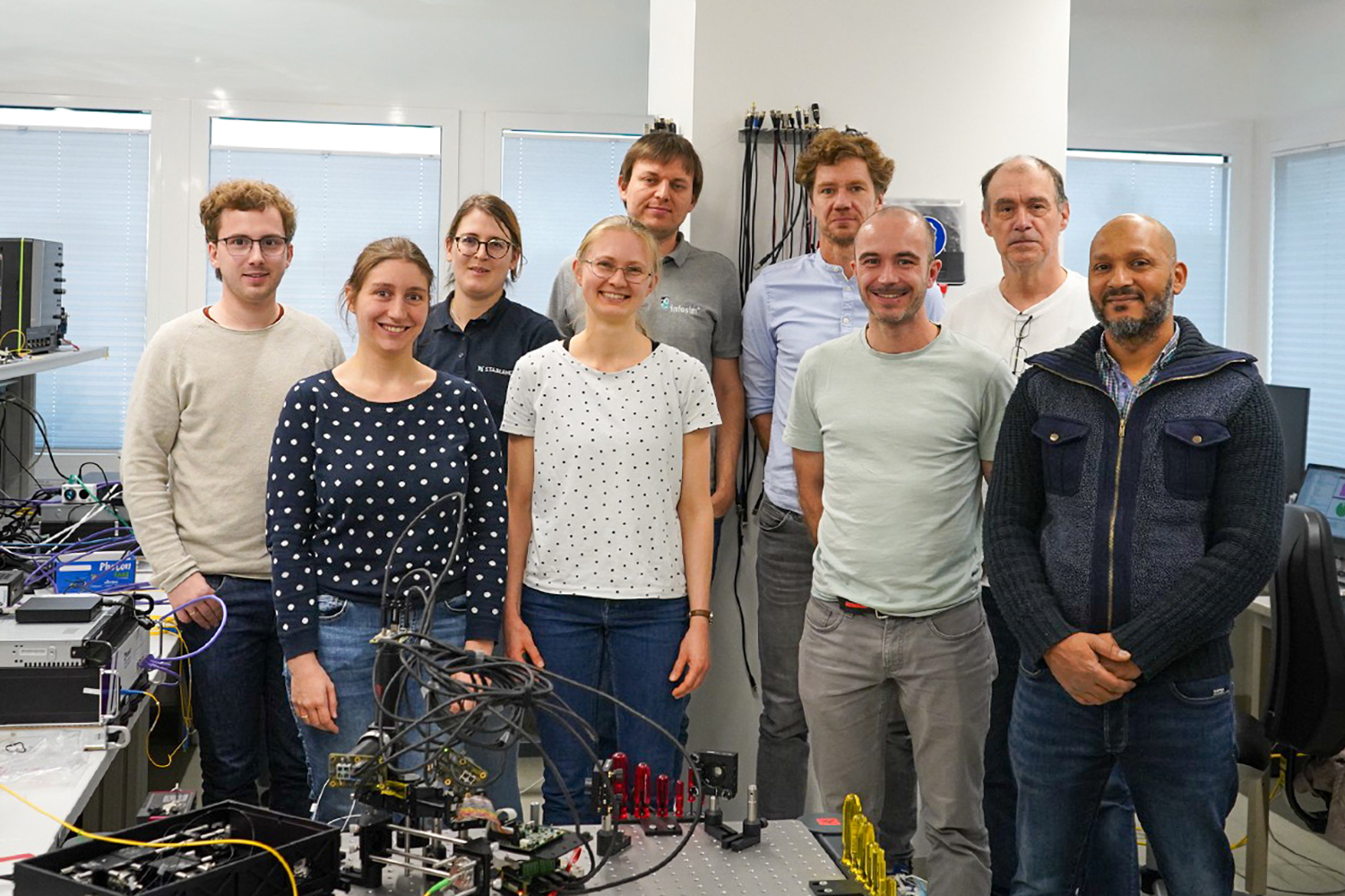
QuINSiDa partners at the final lab demonstration of the integrated optical-wireless security stack.
Press contacts
- KEEQuant GmbH (Coordinator): Imran Khan, press@keequant.com
- Fraunhofer IPMS: Stephan Kube, stephan.kube@ipms.fraunhofer.de
- Fraunhofer IOF: Daniel Heinig, daniel.heinig@iof.fraunhofer.de
- Infosim: Stefan Kremling, kremling@infosim.net
- TELCO TECH: Bernd Schulz, bschulz@telco-tech.de
- BESCom: Faouzi Takni, faouzi.takni@bescom.de
About KEEQuant
KEEQuant GmbH is a start-up company specializing in quantum-secure communications. Its core business is the development and sale of Quantum Key Distribution (QKD) systems, Key Management Systems (KMS), and hybrid applications of post-quantum cryptography (PQC). The miniaturization of QKD technology onto photonic chips, together with certification and approval of the overall system, forms the foundation for long-term secure communications. This helps ensure that users’ security-critical data flows remain protected against unauthorized access even in future threat scenarios, such as attacks using powerful quantum computers.
Funding acknowledgment
QuINSiDa was funded by the German Federal Ministry of Research, Technology and Space (BMFTR) under project numbers 16KISQ082K, 16KISQ083-6, within the funding measure “Lokale Netze zur Quantenkommunikation (Q-LAN)”.
Press Release (long version/DE)
Optische drahtlose quantensichere Kommunikation: Freistrahl-QKD und Li-Fi in einem System
Das deutsche QuINSiDa-Konsortium hat einen bedeutenden Schritt in Richtung mobiler quantensicherer Kommunikation erreicht. Es demonstrierte einen einzigartigen Freistrahl-Datenübertragungskanal, der erstmals Li-Fi sowie die wichtigsten Implementierungen der Quantenschlüsselverteilung (QKD: Quantum Key Distribution) unterstützt. Darüber hinaus integriert das System eine Verschlüsselung mit Schlüsselmanagement (KMS: Key Management System) und Monitoring und verdeutlicht damit die technologische Reife dieses Ansatzes. Diese Architektur ermöglicht die Bereitstellung quantensicherer Schlüssel, ohne auf Glasfaser oder Funk angewiesen zu sein, und eröffnet neue Möglichkeiten für Hochsicherheitsnetzwerke, bei denen eine flexible Infrastruktur wünschenswert ist.

Illustration der QuINSiDa-Vision: quantensichere optische drahtlose Verbindungen zwischen fester Infrastruktur und mobilen Plattformen (z. B. Fahrzeuge, Schiffe, Drohnen, usw.) – unter Verwendung von Freistrahl-QKD und Li-Fi, integriert mit Schlüsselmanagement, Verschlüsselung und Netzwerküberwachung.
Bislang basierten die meisten Quantentelekommunikationssysteme auf dedizierten Glasfasernetzen, was ihre Flexibilität und Einsatzmöglichkeiten einschränkte. QuINSiDa hat nun im Labor einen integrierten, optisch drahtlosen Quantensicherheitsaufbau entwickelt, der Freistrahl-Continuous- und Discrete-Variable QKD (CV-/DV-QKD) mit Li-Fi kombiniert und mit einer Verschlüsselung samt Schlüsselmanagement (KMS) und Monitoring erweitert.
Das System arbeitet über eine optische Sichtverbindung (line-of-sight) und ermöglicht eine quantensichere Schlüsselverteilung für Anwendungen in der zivilen kritischen Infrastruktur (z.B. Vernetzung im maritimen Bereich), Industriecampus, Luftfahrt, Automobilumgebungen, temporäre sichere Netzwerke sowie feste-zu-mobile Verbindungen. Das Design erlaubt eine komfortable Bereitstellung und Überwachung des Systems und bleibt dabei kompatibel mit bestehenden Sicherheits-Workflows.
Mit dieser Entwicklung rückt Deutschland einem Zukunftsszenario näher, in dem quantensichere Kommunikation zunehmend für mobile Sicherheitsanwendungen genutzt wird, die überall dort eingesetzt werden können, wo optische drahtlose Verbindungen möglich sind. Dies bringt quantensichere Verschlüsselung in reale Betriebsumgebungen und bietet ein leistungsfähiges Werkzeug zum Schutz kritischer Infrastrukturen.
Technische Highlights
Der Durchbruch wurde in einem Ansatz erzielt, der auf einer Kombination von Li-Fi und QKD basiert und eine Sichtverbindung ermöglicht. Dabei werden Li-Fi und QKD in derselben optischen drahtlosen Umgebung integriert:
- Continuous-Variable QKD bei 1550 nm
- Discrete-Variable QKD bei 810 nm
- Li-Fi im Bereich von 850–940 nm
Die Wellenlängentrennung sowie die optische Filterung ermöglichen den gleichzeitigen Betrieb aller drei Systeme, ohne dass dabei gegenseitige Störungen auftreten. Das Post-Processing der QKD-Daten erfolgt über die Li-Fi-Verbindung, anstatt einen dedizierten Kanal zu beanspruchen. Die Li-Fi Verbindung ist also der einzige Kanal, der für die klassische Kommunikation notwendig ist.
Schematische Darstellung des technologischen Aufbaus: Unten erzeugt das QKD-System quantensicheres Schlüsselmaterial mithilfe der quantenbasierten Freistrahlverbindung (PAT) und des Li-Fi-Kanals. Die Schlüssel werden vom KMS abgerufen und verwaltet. Der Encryptor übernimmt die Nutzdaten aus der Benutzeranwendung – beispielsweise bei Bob – und verschlüsselt sie mit einem Schlüssel aus dem KMS. Die verschlüsselten Daten werden über die Li-Fi Verbindung an die zweite Partei – Alice – gesendet. Alices Encryptor entschlüsselt die Daten mit dem symmetrischen Schlüssel, der aus ihrem synchronisierten KMS abgerufen wird.
Die Aufrechterhaltung einer stabilen optischen Freistrahlverbindung erfordert eine präzise Ausrichtung, welche das QuINSiDa-System mithilfe eines Pointing/Acquisition/Tracking-Subsystems (PAT) erreicht. Li-Fi unterstützt die Identifizierung bzw. Lokalisierung der Endpunkte und stellt einen Feedback-Kanal bereit, wodurch das PAT die Ausrichtung für die Quantenverbindung erfassen und aufrechterhalten kann. Im Projekt wurde ein Schnittstellenkonzept implementiert, bei dem sowohl CV-QKD als auch DV-QKD zum Einsatz kamen und alle für QKD relevanten Signaleigenschaften erhalten bleiben. Die Steuerung und Telemetrie des PAT sind vollständig in den gesamten Kommunikationsfluss integriert. Gleichzeitig werden Netzwerkmanagement-Workflows sowie Telemetrie (z.B. über einen gNMI-basierten Ansatz) an QKD-/Li-Fi-/PAT-Komponenten angepasst. Damit entsteht ein End-to-End-System, das über eine reine Labordemonstration hinausgeht und für reale Einsätze in Bereichen mit erhöhten Sicherheitsanforderungen ausgelegt ist.
Konsortium
QuINSiDa wurde von einem Konsortium aus sechs Partnern durchgeführt: KEEQuant GmbH (Koordination; CV-QKD, Integration des Schlüsselmanagements), Fraunhofer-Institut für Photonische Mikrosysteme IPMS (Li-Fi- und Freistrahl-Verbindungskomponenten; PAT), Fraunhofer-Institut für Angewandte Optik und Feinmechanik IOF (Beitrag zu DV-QKD), Infosim GmbH & Co. KG (Integration von Monitoring- und Netzwerkmanagement-systemen), TELCO TECH GmbH (Integration der Verschlüsselung) sowie BESCom Elektronik GmbH (Anwendungsfälle, Transfer und Verbreitung).
QuINSiDa-Partner bei der finalen Labordemonstration des integrierten optischen drahtlosen Sicherheits-Stacks.
Presse Kontakt
- KEEQuant GmbH (Koordinator): Imran Khan, press@keequant.com
- Fraunhofer IPMS: Stephan Kube, stephan.kube@ipms.fraunhofer.de
- Fraunhofer IOF: Daniel Heinig, daniel.heinig@iof.fraunhofer.de
- Infosim: Stefan Kremling, kremling@infosim.net
- TELCO TECH: Bernd Schulz, bschulz@telco-tech.de
- BESCom: Faouzi Takni, faouzi.takni@bescom.de
Über KEEQuant
Die KEEQuant GmbH ist ein Start-up-Unternehmen mit Spezialisierung auf quantensichere Kommunikation. Ihr Kerngeschäft ist die Entwicklung und der Vertrieb von Systemen zur Quantenschlüsselverteilung (QKD), Key-Management-Systemen (KMS) sowie hybriden Anwendungen der Post-Quanten-Kryptografie (PQC). Die Miniaturisierung der QKD-Technologie auf photonische Chips bildet zusammen mit der Zertifizierung und Zulassung des Gesamtsystems die Grundlage für langfristig sichere Kommunikation. So bleibt gewährleistet, dass sicherheitskritische Datenströme der Nutzer auch in zukünftigen Bedrohungsszenarien — etwa bei Angriffen mit leistungsfähigen Quantencomputern — vor unbefugtem Zugriff geschützt bleiben.
Förderung Anerkennung
QuINSiDa wurde vom Bundesministerium für Forschung, Technologie und Raumfahrt (BMFTR, ehemals BMBF) unter den Projektnummern 16KISQ082K, 16KISQ083-6, im Rahmen der Fördermaßnahme „Lokale Netze zur Quantenkommunikation (Q-LAN)“ gefördert.
Usage rights and permissions
Press release text
This press release may be reproduced, republished, and shared in whole or in part for editorial, news, and informational purposes, provided the QuINSiDa consortium is credited as the source.
Image and media assets
Unless otherwise indicated, photographs, renderings, and other media assets on this page are provided solely for editorial use in connection with coverage of this announcement and/or QuINSiDa consortium. Please credit: QuINSiDa consortium. No use for advertising, merchandising, resale, or other commercial exploitation. No alterations except proportionate cropping, resizing, and minor technical adjustments. All other rights reserved.
Ressources
Press release
Images
- Image 1: Harbour-Control-Station
- Image 2: Schematic of the technological stack
- Image 3: Group picture of the consortium